EU Revises ISO 15118 for Plug & Charge
On July 16, 2026, the European Commission released Commission Regulation (EU) 2026/1389, revising the implementation framework tied to ISO 15118 and setting a new compliance threshold for Plug & Charge terminals placed on the EU market. From January 1, 2027, those products must pass both V2G readiness verification and bidirectional electricity metering compliance testing. For companies involved in EV charging equipment exports, certification, OEM supply, and delivery planning, this matters because the change reaches beyond technical specifications and into market access, approval timing, and shipment preparation.
What the new requirement formally changes
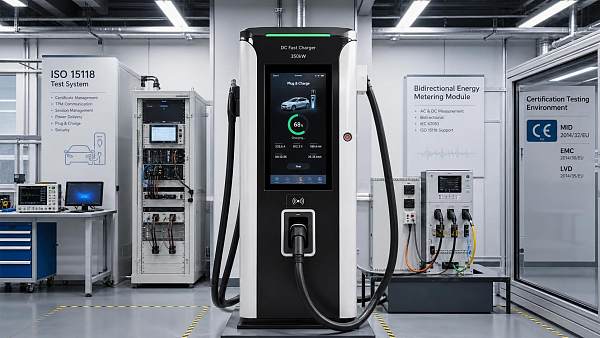
The confirmed change is that the European Commission issued Commission Regulation (EU) 2026/1389 on July 16, 2026, to revise the implementation framework for ISO 15118. Under that revision, all Plug & Charge terminals placed on the EU market from January 1, 2027 must complete V2G functionality readiness verification and bidirectional electricity metering compliance testing. The information provided also makes clear that this revision directly affects product design, CE type certification pathways, and OEM delivery cycles for Chinese EV charging equipment exporters.
Where the pressure is likely to appear first
Export-facing product development
From an industry perspective, manufacturers shipping Plug & Charge equipment into the EU are likely to feel the change first at the design stage. The reason is straightforward: the new market-entry condition is tied to V2G readiness and bidirectional metering compliance, so development teams will need to check whether existing product configurations, architecture choices, and technical documentation can support those verification and testing steps. What deserves closer attention is whether products already planned for EU placement remain aligned with the revised compliance path.
Certification and testing workflows
Certification-related businesses and internal compliance teams may be affected because the stated requirement changes the route products must follow before being placed on the EU market. Analysis shows that CE type certification planning can no longer be viewed only through the previous Plug & Charge implementation assumptions described in the input; it now has to be read together with the added verification and testing obligations. In practice, companies should pay closer attention to technical files, test evidence, and the sequencing between design completion and certification submission.
OEM delivery and procurement coordination
OEM programs and procurement functions may also see operational effects, since the provided information explicitly points to delivery-cycle impact. Observably, once compliance testing becomes a precondition for EU market placement from the stated date, supply agreements, model-selection decisions, and production scheduling may all need closer alignment with certification timing. Buyers and supply-chain coordinators should therefore watch for changes in product qualification status, delivery commitments, and document readiness connected to EU-bound shipments.
Practical issues companies should now track
Review whether current EU-bound models still fit the revised path
Analysis shows that the immediate task is not broad strategy but product-by-product review. Companies should examine which Plug & Charge terminals are intended for EU placement on or after January 1, 2027 and whether those models are already prepared for V2G readiness verification and bidirectional metering compliance testing. This is especially relevant where export planning, OEM commitments, and technical specifications were set before the revision was issued.
Recheck CE type certification planning and evidence packages
What deserves closer attention is the certification route itself. Because the input states that the revision directly affects CE type certification pathways, companies should revisit how technical files, test plans, declarations, and supporting compliance materials are being prepared. The available information does not provide procedural detail, so this should be understood as a compliance review priority rather than as confirmation of a fully defined execution method.
Watch delivery timing and procurement documentation closely
Observably, delivery risk may emerge when product design, testing completion, and customer handover are not aligned. Exporters, OEM suppliers, and procurement teams should monitor whether tender documents, purchase specifications, and delivery schedules need adjustment to reflect the new requirement date. Since no further execution details were provided, the key point for now is to avoid assuming that existing schedules or document sets remain sufficient without revalidation.
Follow later wording and implementation signals
It is more appropriate to understand this as a confirmed rule change with further implementation questions still worth tracking. Companies should continue watching for later official wording, certification interpretation, and market-facing compliance expectations that could affect how the requirement is applied in practice. This is particularly important for firms managing after-sales obligations, traceability records, or multi-party OEM delivery chains.
Why this should be read as both a rule change and an execution signal
Analysis shows that this development is not just a technical update to a standard reference. It signals that Plug & Charge access to the EU market is being tied more directly to V2G readiness and compliant bidirectional metering capability. At the same time, based on the information provided, it would be premature to treat all downstream implementation details as settled. It is more appropriate to understand this as a confirmed compliance direction that now requires close attention to how certification practice, tender requirements, and delivery expectations are expressed in the next stage.
How the market is likely to interpret it for now
For the industry, the practical significance lies in timing and scope rather than headline value. The change is already defined in regulatory terms and linked to a clear effective date, so it should be treated as an active market-access condition rather than a distant policy discussion. At the same time, a neutral reading is still necessary: the information provided confirms the new requirement and its likely pressure points, but not the full operational detail of enforcement. Current market participants are best served by reading this as a landed compliance change accompanied by an ongoing need to track implementation signals.
Basis of this article and what still needs verification
This article is based on the user-provided news title, event date, and event summary. For developments of this kind, source types commonly relevant for follow-up verification include official regulatory releases, publications by supervisory authorities, trade or customs authorities, industry association notices, standard-setting documents, and reporting by established professional media. A specific official source link was not provided in the input, so that point still requires continued verification. Further observation should focus on detailed implementation wording, certification interpretation, tender-document changes, industry feedback, and how companies adjust execution in response.
Get weekly intelligence in your inbox.
No noise. No sponsored content. Pure intelligence.
 Oct 27, 2026Choosing a Battery Energy Storage Cabinet Supplier: Safety and Warranty ChecksChoosing a Battery Energy Storage Cabinet Supplier: Safety and Warranty Checks
 Oct 26, 2026Jinan Expands Residential V2G Use With 21 Dedicated 7 kW ChargersJinan Expands Residential V2G Use With 21 Dedicated 7 kW Chargers
 Oct 26, 2026Charging Station Billing Software: Evaluating Tariffs, Payments, and ReconciliationCharging Station Billing Software: Evaluating Tariffs, Payments, and Reconciliation
 Oct 25, 2026Servotech Unveils Dynamix360 and Nexus120 Fast Chargers at REI Expo 2026Servotech Unveils Dynamix360 and Nexus120 Fast Chargers at REI Expo 2026
 Oct 25, 2026E-Mobility Billing Platform Pricing: Setup, Subscription, and Transaction FeesE-Mobility Billing Platform Pricing: Setup, Subscription, and Transaction Fees
 Oct 24, 2026Chery Unveils 1.44 MW Volt-dragon Supercharging System and V2G Smart Charging CenterChery Unveils 1.44 MW Volt-dragon Supercharging System and V2G Smart Charging Center
 Oct 24, 2026How to Set Up EV Charging Billing and Parking Discounts at Shopping MallsHow to Set Up EV Charging Billing and Parking Discounts at Shopping Malls
 Oct 23, 2026Electrify America Opens Its Largest Charging Station in OrlandoElectrify America Opens Its Largest Charging Station in Orlando
 Oct 23, 2026How Thermal Monitoring and Derating Reduce Overheating in EV Charging ConnectorsHow Thermal Monitoring and Derating Reduce Overheating in EV Charging Connectors
 Oct 22, 2026NOX Energy Expands Melbourne Apartment EV Charging Network to Nearly 1,900 HomesNOX Energy Expands Melbourne Apartment EV Charging Network to Nearly 1,900 Homes
 Oct 22, 2026Vehicle-to-Grid Services for Depots: Can Revenue Justify the Costs?Vehicle-to-Grid Services for Depots: Can Revenue Justify the Costs?
 Oct 21, 2026CATL Unveils Dual-Battery Range Extension and Heavy-Truck Battery-Swapping PlanCATL Unveils Dual-Battery Range Extension and Heavy-Truck Battery-Swapping Plan
 Oct 20, 2026Eberspaecher Vecture Unveils GuardIon-IQ Modular BMS for 12–1500V Battery SystemsEberspaecher Vecture Unveils GuardIon-IQ Modular BMS for 12–1500V Battery Systems
 Oct 20, 2026EV Charging Gateway Software Pricing: License, Integration, and Support CostsEV Charging Gateway Software Pricing: License, Integration, and Support Costs
 Oct 19, 2026OCPP Platforms: Compatibility Checks for Mixed-Brand Charging NetworksOCPP Platforms: Compatibility Checks for Mixed-Brand Charging Networks
 Oct 18, 2026Choosing Fleet Charging Software for Depots With Limited Grid CapacityChoosing Fleet Charging Software for Depots With Limited Grid Capacity
 Oct 17, 2026Battery Swapping Infrastructure Suppliers: A Heavy-Truck Procurement ChecklistBattery Swapping Infrastructure Suppliers: A Heavy-Truck Procurement Checklist
 Oct 16, 2026How to Evaluate Fleet Charge Point Management Systems for Power-Limited DepotsHow to Evaluate Fleet Charge Point Management Systems for Power-Limited Depots
 Oct 15, 2026Depot Charging ROI: How Grid Upgrade Costs and Fleet Utilization Affect PaybackDepot Charging ROI: How Grid Upgrade Costs and Fleet Utilization Affect Payback
 Oct 14, 2026Vehicle-to-Grid Infrastructure Costs for Fleets: What to Include in Your BudgetVehicle-to-Grid Infrastructure Costs for Fleets: What to Include in Your Budget
 Oct 13, 2026Bus Fleet Charging Systems: How to Meet Departure Times Within Grid LimitsBus Fleet Charging Systems: How to Meet Departure Times Within Grid Limits
 Oct 12, 2026How EV Drivers Can Use Roaming Networks Across Germany Without Billing SurprisesHow EV Drivers Can Use Roaming Networks Across Germany Without Billing Surprises
 Oct 11, 2026How to Size Solar EV Charging Stations for Fleet Depots and Daily Charging DemandHow to Size Solar EV Charging Stations for Fleet Depots and Daily Charging Demand
 Oct 10, 2026How Remote Charger Monitoring Prevents Downtime Across Multi-Site EV FleetsHow Remote Charger Monitoring Prevents Downtime Across Multi-Site EV Fleets
 Oct 09, 2026RFID Charging Access Control: How Reader IDs Map to OCPP AuthorizationsRFID Charging Access Control: How Reader IDs Map to OCPP Authorizations
 Oct 08, 2026How Remote Charger Management Alerts Prevent Downtime at Multi-Site EV FleetsHow Remote Charger Management Alerts Prevent Downtime at Multi-Site EV Fleets
 Oct 07, 2026How to Assess Battery Swapping Stations for High-Utilization Fleet DepotsHow to Assess Battery Swapping Stations for High-Utilization Fleet Depots